ORIGINALLY RECORDED BY SIOUXSIE AND THE BANSHEES
Vocalist Leslea Keurvorst joins us this month with a fittingly spine-tingling performance for the holiday season.
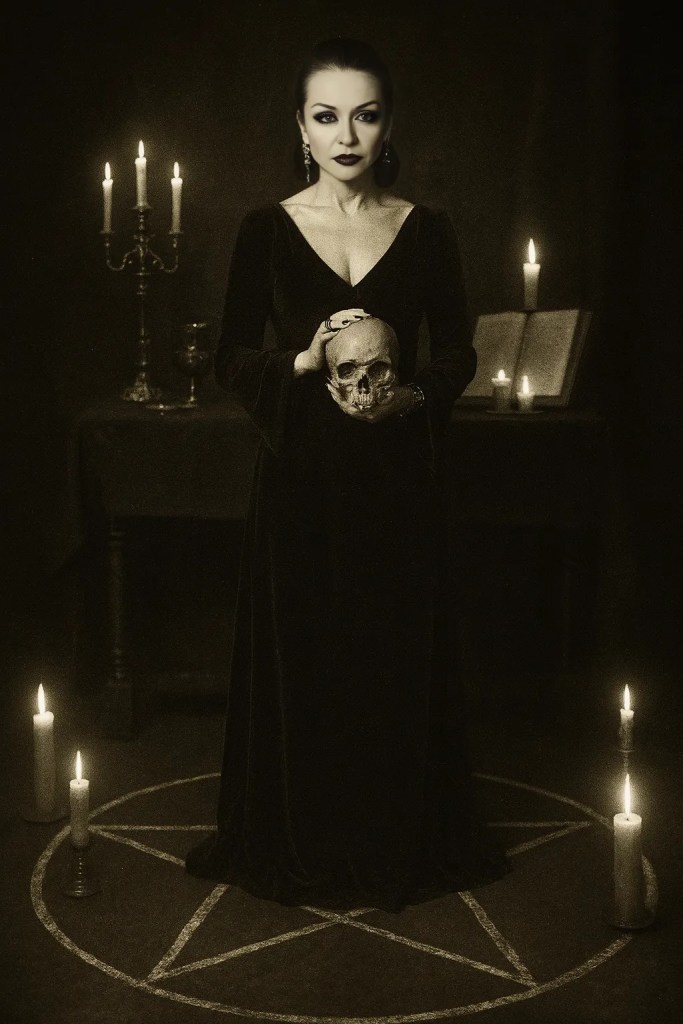
For our special Halloween Heavy Friends release, what could be more fitting than diving into a goth classic that’s practically ingrained into many of our DNA? This month, we take on “Spellbound” by Siouxsie and the Banshees — a track that personally shaped me long before I ever stepped into a rehearsal room.
I still remember buying the Juju album the week it came out, back in 1981, when I was staying in Berlin at the impressionable age of 16. That record hit like nothing else — all atmosphere, rhythm, and tension. The sound of Budgie’s toms, John McGeoch’s swirling guitars, and Siouxsie’s voice cutting through the fog — it was dark, hypnotic, and exhilarating. Even then, it felt like the future.
A Bit of Banshees History
Siouxsie and the Banshees began almost by accident — and in pure punk fashion. Their first-ever show was at the 100 Club Punk Festival in September 1976, when Siouxsie Sioux and bassist Steven Severin volunteered to fill a last-minute slot. They had no songs, no plan, just nerve.
Their impromptu lineup featured Sid Vicious on drums (before joining the Sex Pistols) and Marco Pirroni on guitar (later of Adam and the Ants). They performed a 20-minute improvised version of “The Lord’s Prayer” — a chaotic, confrontational collage of punk, prayer, and noise.
Unlike many of their punk peers who rushed into major label deals during the 1977 signing frenzy, Siouxsie and The Banshees held out. They refused to compromise, insisting on complete artistic control. When they finally signed with Polydor in mid-1978, they arrived not as a raw punk band but as a fully realized creative force. Their stark, serrated sound helped define the shift from punk’s chaos to post-punk’s darker, more experimental territory — a path that many would follow, but few would lead as boldly.
Their debut single “Hong Kong Garden” (August 1978) hit #7 on the UK charts — a shimmering, cinematic anthem that proved punk could evolve. Their first two albums, The Scream (1978) and Join Hands (1979), solidified their cult status — cold, poetic, and uncompromising.
In September 1979, turmoil erupted when guitarist John McKay and drummer Kenny Morris walked out mid-tour in Aberdeen. But the much-publicized walkout didn’t sink the band. If anything, it blew the doors wide open. After a brief rescue by The Cure’s Robert Smith, the Banshees entered a period of reinvention that led directly to their most celebrated lineup and the era-defining records that pushed post-punk into new territory.
Reinvention and the Kaleidoscope Era
Enter Budgie, formerly of The Slits, bringing a fluid, tribal power to the drums. Their next album, Kaleidoscope (1980), marked a bold sonic shift — using synths, effects, and a more exploratory palette, produced again by Nigel Gray (The Police).
Then came John McGeoch, whose guitar work with Magazine had already set a new standard for post-punk sophistication. His addition, along with Budgie’s rhythmic innovation, completed what most fans consider the definitive Banshees lineup:
Siouxsie Sioux, Steven Severin, Budgie, and John McGeoch.
This lineup created Juju (1981) — the record that transformed the Banshees from a punk survivor into a full-blown dark art form.
Juju and “Spellbound”
Recorded at Surrey Sound Studios with Nigel Gray, Juju was lush, moody, and razor-sharp — a perfect collision of rhythm, atmosphere, and melody.
The lead single, “Spellbound,” released in May 1981, was instantly iconic — McGeoch’s cascading guitars, Budgie’s hypnotic toms, and Siouxsie’s soaring vocals created something that felt both cinematic and supernatural. The track hit #22 on the UK charts and helped push Juju to #7. To this day, it’s one of the great moments of post-punk alchemy.
Siouxsie once described “Spellbound” as “a joyful kind of whirlwind — but with dark edges.” And that’s exactly what it is.
Berlin, Trains, and Finding My Way
When I bought Juju that week in Berlin, I was on a summer-long trip through Europe. I had run off from a rather difficult and unhealthy home life to go live on the trains for a summer with a Eurail pass — sleeping on the trains and waking up in a new city every day, maybe staying for a few days in a hostel. With a backpack, a notebook, and a vague sense that I was supposed to be “finding myself.” Admittedly, I may have also been a tad obsessed by Kraftwerk’s Trans Europe Express and Autobahn records. I had a cousin, Detlef, who lived in Berlin and let me crash at his place for a while — a proper bed, hot showers, and somewhere to think.
So my copy of Juju is a little beat-up as I carried it around Europe that summer, looking for a turntable to play it on. I managed to get it spun from the infamous hash bars in Amsterdam’s red-light district to a quaint little bar outside Athens, where they humoured me for maybe a song and a half before shooing me off with an annoyed look on their faces.
At that point, I was trying to figure out what I really wanted to do with my life. There were two things on the horizon: music or filmmaking.
The more I thought about it, the clearer it became. Film seemed like a beautiful mess — so many moving parts, producers, co-producers, executive producers — layers of bureaucracy between an idea and its execution. Music, by contrast, felt immediate, pure, direct. You could pick up a guitar, or in my case, a synth, hit record, and create a world by the end of the day. That simplicity, that autonomy, was magnetic.
Even with my not-yet-fully-matured sixteen-year-old brain, music felt like the more truthful route to art. So somewhere between train stations and turntables with my copy of Juju in hand, I decided — music it is.
Proto-Goth Roots
This one also harkens back to my proto-goth roots and ties strongly to my own teenage years.
I started my first band at 17, with fellow Heavy Friends Ian Blurton on drums, Crawford Teasdale on guitar, and the long-lost Nancy Prescott on vocals. We called ourselves Slightly Damaged — a psychedelic punk band that fell right into the early 1980s pre-goth scene. Lots of makeup, teased hair, and a zebra-striped or rooster red mohawk or two. We also made our own clothes at the time, and that garnered a two-page spread in one of Now Magazine’s early fashion columns.
We were a bit obsessed with the emerging Batcave movement in England and bands like Bauhaus, The Cure, the Virgin Prunes, and Specimen. I think it would be a few more years before the world would actually call it “goth.” Back then, we jokingly called it “batcave” or “death cult” music.
Nancy — who was also my girlfriend at the time — and I lived and breathed those records. The Banshees’ Juju, their brilliant follow-up A Kiss in the Dreamhouse, and The Creatures’ first album (Siouxsie and Budgie’s side project) were the soundtrack to a lot of teenage sex and experimentation.
To this day, any one of those records can instantly conjure a vision of Nancy — naked under her mother’s old fur coat — an item we quite literally destroyed in the first year and a half of our relationship. Those records didn’t just soundtrack our lives — they were woven into them.
So yeah, this song connects to me on a lot of levels. It’s not just a cover — it’s a time machine ingrained into my DNA that conjures up a kaleidoscopic world of images and emotions for me. .
The Heavy Friends Version
Seeing its legendary status and my personal connections, I did not want to mess with this one too much, and the goal was to make it our own, but stay reverent. We first recorded our version of “Spellbound” around 2011, but it didn’t quite land. There were timing and tightness issues, the tempo was too fast, and the vocal delivery felt rushed. Basically, it didn’t hit the mark.
For this new version, I went back to those original tracks and did some micro-editing, beefed up the drums and bass with some modern studio wizardry, and slowed it down about 6 BPM. The result feels deeper, groovier — like it found its center.
The incomparable Leslea Keurvorst then re-did the vocal, and I believe she really nailed it this time around.
Gear and Players
Gear-wise, it was the usual suspects:
Vox, Fender, and Standel amps, plenty of ribbon mics, and some vintage strips to keep things warm, analog, and moody.
One notable bit of trivia — this is one of the last Heavy Friends recordings to feature a beautiful vintage Yamaha 12-string guitar, which sadly met a rather violent end in what I can only describe as the worst case of instrument-cide I have personally seen — “gruesomely slaughtered Susan Atkins–style,” 26 stab wounds, no less. A fittingly gothic, yet traumatizing exit to one of our Heavy Friends staple instruments. I will not elaborate more out of consideration for the bereaved.
The lineup:
• Neil Exall – does a brilliant job layering up those guitars and plays the bass as well.
• Damon Richardson – Lays down the beat and mesmerizes with his hypnotic tambourine.
• Leslea Keurvorst – Brings the vibe with another spectacular vocal performance.
• Bernard Maiezza – Apart from the production and mix, I take a bit of a back seat and only add some light orchestration touches.
In the End
Juju remains one of those records that sounds both of its time and utterly timeless. Revisiting “Spellbound” brought me back to that first spark — to Berlin, to teenage bedrooms lit by blacklight, incense, and an awakening world of wonder, to the sound of discovering something dark and beautiful that haunts one forever.
Hope you enjoy this one as much as we enjoyed conjuring it up again.
We will back mid-month for our November release, where we go all “cowboys on mescaline”.
— Bernard / Heavy Friends
 Heavy Friends
Leave a comment